The Boruca People

THE MASKS AND BORUCA PEOPLE
You’ve probably ran into the colourful masks that seem to permeate our area – homes, shops, pubs, restaurants, and medical and real estate offices proudly display the vibrant artisan creations. But did you know that the masks are made by an indigenous tribe, the Boruca people, who live on a protected reservation in the mountains just outside Palmar? Come along as we visit the indigenous community where the Boruca people proudly craft the masks and other traditional products in numerous workshops and art shops scattered around the town. There is SO much more to the Boruca culture than the masks, and it is unfortunate most people have NO IDEA about the story and colourful traditions of these indigenous people of Costa Rica.
THE CENTRE OF THE BORUCA CULTURE
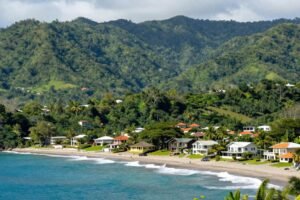
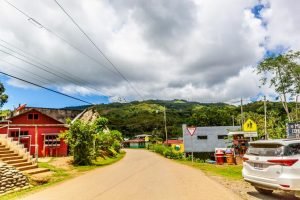
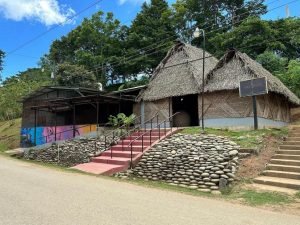
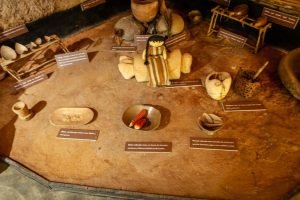
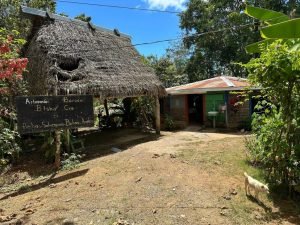
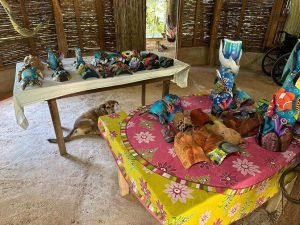
Today there are about 2,500 Boruca people most living around the town of Boruca about 32 km from Palmar, as well as in a town called Rey Curré. Both settlements are surrounded by lands that have been set aside for the tribe. Boruca is a small town but contains many amenities – a wonderful museum that tells the story of the Boruca people, a medical clinic, community hall, a local cultural radio station, pubs and restaurants, police facilities, a school and sport fields, general and food stores, a few accommodation options and MANY artesian shops where the famous masks and other crafts are made, in some cases you can see them in various state of finish. In fact, over 80% of the residents sell masks and other crafts right out of their homes!
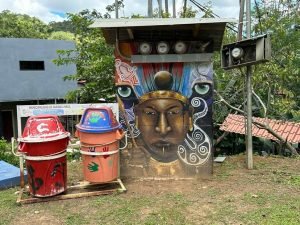
Although isolated, there is running water, electricity and cell phone service throughout the town. The locals are very open and welcoming and the town is painted in bright traditional murals creating an inviting atmosphere. Most of the Borucan people support themselves through small scale agriculture, service economy, and the crafting of the masks and other traditional Boruca objects such as naturally-dyed woven goods, bows and arrows, cow hide drums, daggers, and jewelry.

THE BORUCA PEOPLE
The Ancestors
Their ancestors lived in these parts long before the Spanish conquest, first being described by the Spanish in 1562. They occupied large areas of the southern and Pacific regions of what is now Costa Rica, grouped in three main tribes: Quepoa, Turucaca and Coctú – ruling an area from what is now Quepos all the way to the current Panamanian border, including all of Osa Peninsula. It is the ancestors of these tribes who produced fine gold object and jewellery that grace many museums, as well as the stone spheres which have been found scattered around the region in great numbers. The Boruca were known to be great shipbuilders, sailing their vessels up and down the Terraba River.
Resistance
While their settlements were located right along the central transport route between Panama City and the colonial capital of Cartago, the inaccessibility of their land limited their early interaction with the Spaniards and thus they were able to preserve their language and much of their culture – this was also due to their brave fighting ability in holding off the Spanish incursions. The Spaniard noted the Borucas’ fortified settlements and the fact that women Boruca warriors were a formidable force.
Hardships
However, some Boruca people were eventually subject to hard labour under the Spanish, forced to tend fields, transport grain on their backs for very long distances, and to build canoes without any compensation for their work. Their traditional lands were slowly taken over by the newcomers. Starting in the 1930s and onwards the arrival of banana plantations and workers from around the world, the opening of the Interamerican highway, the arrival of mountain and plateau settlers, and the process of modernization put great pressure on the Boruca peoples’ traditional way of life.
Re-Awakening
The Boruca continued to sustain themselves with small-scale agricultural production and were slowly losing their cultural heritage. In the 1970s, due to the poverty of the people, local women led by Margarita Moralez came together to bring back to life the traditional arts, crafts and way of life of the Boruca. This led to the awakening of their colourful traditions, flourishing of the local economy, awareness being brought to the Boruca people and their history, and major projects being completed in the town such as the construction of the Boruca museum. It is thanks to these women that the Borucan culture is, one again, a part of the Costa Rican landscape.
THE MASKS
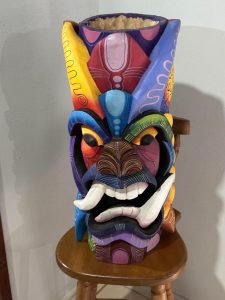
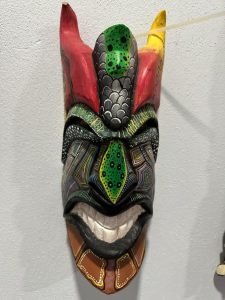
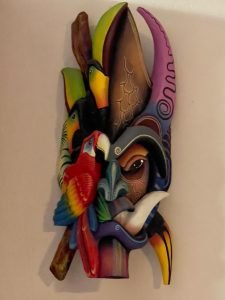
Boruca artisans carve vibrant wooden masks, usually from lightweight balsa. These surreal creations feature jaguars, toucans, hummingbirds, turtles, parrots, butterflies, and jungle plants. Known as ecological or cultural masks, they blend ancestral symbolism with modern artistic flair.
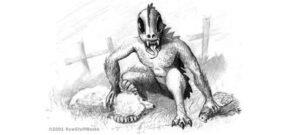
Traditional diablito masks depict fierce, exaggerated faces. They show fangs, horns, bulging eyes, and lolling tongues—how Spanish conquistadores once viewed the Boruca. Each January, locals wear these masks during the Little Devils Festival, a ritual reenactment of colonial encounters. Every participant crafts their own mask, then discards it after the final dance
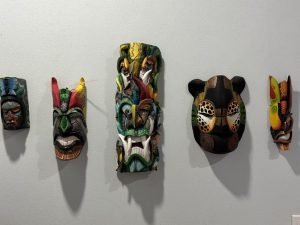
Originally the masks were not painted but the craft evolved to include natural based pigments and, today, modern paints. It can take up to four days to carve a single mask. Traditionally, the men carved the masks and the women painted them; these days a few women are active carvers of the Boruca masks.
THE LITTLE DEVILS FESTIVAL
Each year from December 30 to January 2, the Boruca community hosts the Juego de los Diablitos (the Games of the Boruca Little Devils), or The Little Devils Festiva. This is a four-day celebration of resistance and identity. A second round unfolds in early February in nearby Rey Curré. Locals wear hand-carved devil masks, symbolizing the Boruca people, while one participant plays the bull, representing Spanish conquistadores.
Through ritual dances and mock battles, the festival reenacts the clash between Indigenous resilience and colonial force. Its roots stretch back to the era of Spanish conquest. In 2017, Costa Rica officially recognized the event as Intangible Cultural Heritage, honoring its deep historical and spiritual significance

The Hierarchy
The devils follow a clear hierarchy. The Greater Devil leads the action. Herder Devils round up those who stray from the games. Lesser Devils engage in battle. Other ranks support the ritual, each with a distinct role in the drama.
Only one bull mask exists, and it’s saved for the next year’s festival. Crafted from wood and real bull horns, it stands apart from the devil masks. Musicians heighten the atmosphere with flute, cajón, guitar, violin, and accordion.
Each day of the festival retells the Boruca story. The bull battles the devils in a symbolic clash of struggle, defeat, rebirth, and triumph.

The Rules
There are a few rules to the games, which are meant to be physical but not violent, such as a need to obey the Greater Devils and a request not to attack the foreigners (tourists).
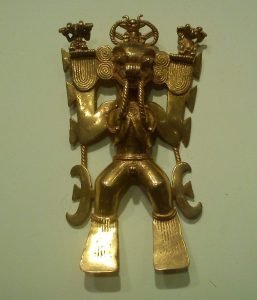
Some researchers believe the festival has deeper roots. The Boruca may have adapted it to reflect the arrival of the Spanish. Archaeologists have recovered pre-Columbian artifacts showing masked figures and dancers, suggesting the tradition predates colonization.
La chicha fuels the celebration. This fermented corn drink holds cultural importance. Each household prepares chicha and offers it to the Little Devils as they visit door to door. It’s a way for the Boruca to honor the devils for resisting the Spanish, symbolized by the bull.
THE BORUCA LANGUAGE
The Boruca language—also called Bronka, Bronca, or Brunca—is at risk of vanishing. It’s considered the most endangered of Costa Rica’s six native languages. Agencies have labeled it “critically endangered,” “dormant,” and even “extinct.” A 1992 study found only 10 fluent speakers, all over age 50, and 50 semi-fluent speakers. By 2019, no fluent speakers remained. About 15 individuals still hold partial knowledge—mostly teachers and young students.
Exact numbers remain unclear, but they are extremely low. Still, hope persists. Boruca elementary schools now teach Brunca, and local enthusiasm for language revival is strong. The Costa Rican Ministry of Culture supports these efforts with grants to include Brunca in school curricula.
TRADITIONAL DISHES
There are a few dishes unique to the Boruca culture – while the people now regularly consume the food that is typical of the rest of Costa Rica, these special dishes ares till made and enjoyed to this day (amongst many others):
CARNE AHUMADA – Pork seasoned with onions, salt and garlic then smoked over a fire.
PALMITO – A heart of palm cut up and mixed with chili and ayote, served with salt water. Prepared for fiestas and special ceremonies.
ZAPITO – Corn and water ground with coconut, then combined with sugar and used as a topping. Served during week-long funeral ceremonies.
TAMALES – can be prepared with rice, corn, or beans mixed with salt and oil and seasoned with chili, onion, or ayote. They are served on special occasions such as birthdays or during guest visits.
CHICHA – A fermented drink made by grinding corn sprouts, adding water, sugar and yeast and then fermenting for a few days. Served on special occasions like the Little Devils Festival.
GETTING THERE
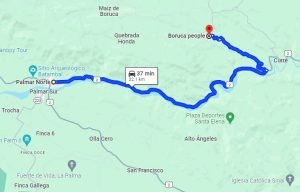
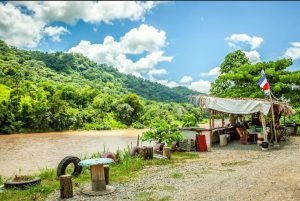
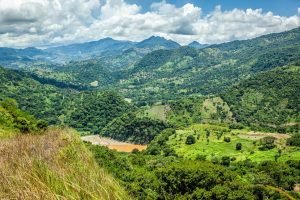
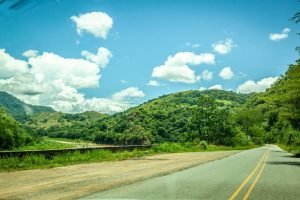
The town is called Boruca, sometimes listed as “Boruca People” on maps. It sits roughly 32 km east of Palmar Norte. From Palmar Norte, follow Ruta Nacional Primera 2 heading east for 24 km. The Terraba River winds beside you on the right. Jungle-covered foothills of the Talamanca range rise around you, filling the view in every direction.
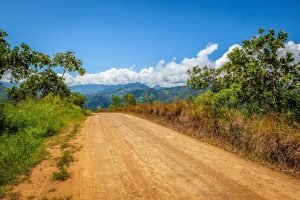
Look for a small left turn marked “Boruca”—it’s easy to miss. This road becomes a dirt and gravel path that climbs over the Talamanca hills for 8 km. Drive with care. The views are breathtaking, and you’ll want to stop for photos along the way. And as you can see, there’s another way to reach Boruca—from the north side.
Costa Rica boasts a deep, engaging and proud culture – from its pre-Colombian roots to current customs that evolved over the past hundreds of years the traditions, music, dance, feasts and festivals are as colorful as the country’s wildlife! RE/MAX WE SELL PARADISE can help you relocate to this amazing country and as you browse our current listings – here – imagine life in such a vibrant and amazing location!