
The Wide-Eyed Sunbittern
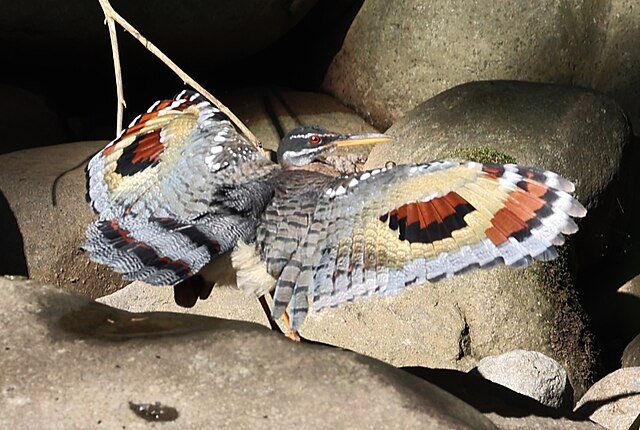
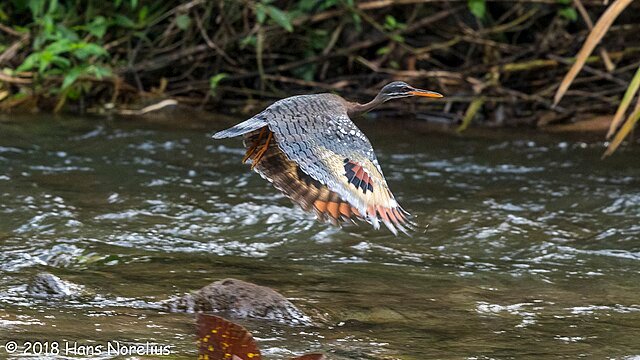
The Sunbittern may not dazzle with bright colors or fame, but it hides a spectacular secret in its wings. When threatened or courting, it flashes vivid ocelli—eyespots that bloom like stained glass across its feathers. These markings confuse predators, startle rivals, and enchant potential mates.
Most of the time, its plumage blends into the forest floor, subtle and earthy. But in motion, it transforms. Wings spread wide, the Sunbittern becomes a living display of evolutionary brilliance—proof that camouflage and spectacle can coexist in one quiet bird.
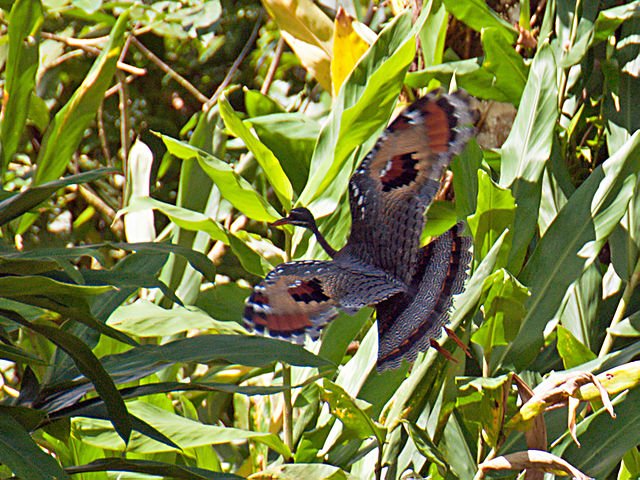
The bird’s name is derived from the eyespots’ resemblance to the sun & her shining bright rays.
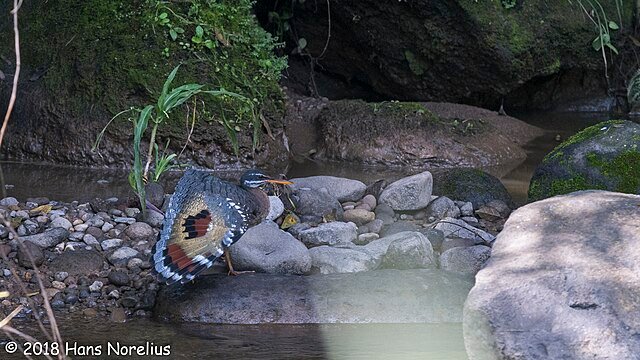
ALL ABOUT THE OCELLUS
We wrote about the Blue Morpho’s bold use of the ocellus in a previous bog. Ocelli, or eyespots, appear across the animal kingdom—from insects and fish to birds, reptiles, and even mammals. These markings mimic eyes, tricking predators into thinking they face a larger, more dangerous creature.
For the Sunbittern, eyespots serve multiple roles. They scare off attackers and redirect strikes away from vital areas. During courtship and competition, the bird flashes its wings to show off these vivid patterns, signaling strength and allure. Sometimes, the display isn’t intentional. While sunning itself to regulate body temperature, the Sunbittern spreads its wings wide—accidentally revealing the stunning ocelli that lie hidden in plain sight.
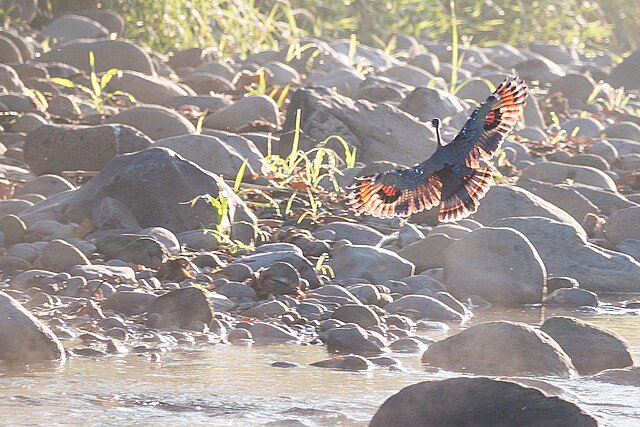
Amongst birds, species of peacocks and pheasants are perhaps the only examples with a similarly impressive ocellus – but none of them wear such sizeable and intimidating ‘eyes’ as the Sunbittern.
TOOL USE
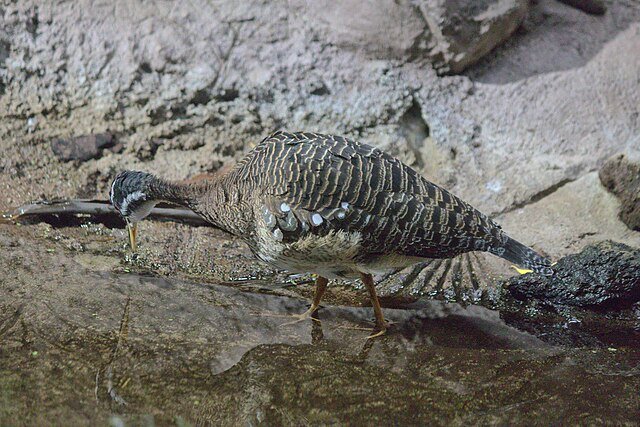
Sunbitterns belong to a rare group of animals that use tools—a trait more often seen in primates or corvids than in wading birds. One remarkable observation showed a Sunbittern placing maggots on the water’s surface to lure fish. When the fish approached, the bird struck with precision and claimed its meal.
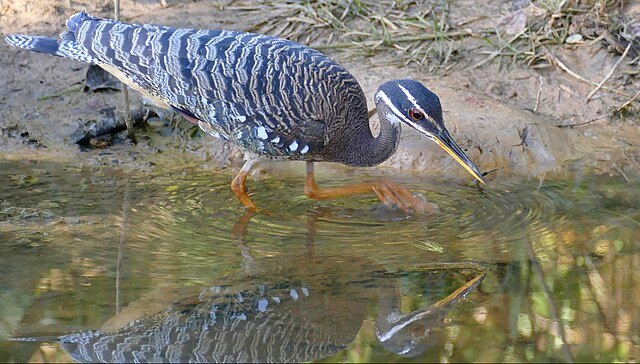
This places the Sunbittern in a very exclusive club amongst select species of apes, monkeys, dolphins, elephants and crows. It is a great evolutionary step where food is not rapidly consumed but rather strategically used to attract a bigger meal – with a very good possibility of the lure being lost.
ANCIENT BIRD WITH FEW LIVING RELATIVES
A Very Small Family
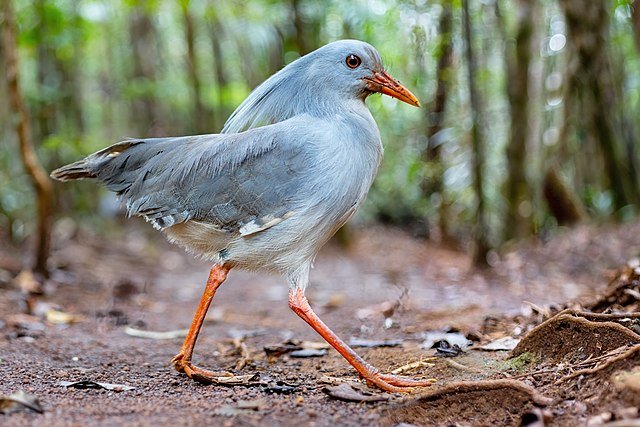
Despite the name, Sunbitterns are not closely related to bitterns or herons. In fact their nearest relative is the Kagu, a bird from the remote islands of New Caledonia nearly 11,000km or 7,000 miles away. So, unbelievably, their nearest cousin is all the way across the Pacific Ocean – and no close relatives remain.
An Ancient Story
The great distance between cousins suggests a Gondwanan origin of the bird – the predecessor of both the Sunbittern and the Kagu lived on the Gondwanan supercontinent before it started to split some 180 million years ago. So it is thought that the Sunbittern is an ancient bird, a living fossil whose evolutionary relatives date back 40 million years and its bird-like predecessors date back all the way to the days of Gondwana when birds, as a Class, were just beginning to emerge. That is also when dinosaurs sroamed and would continue to roam for another 80 million years.

The Sunbittern stands alone in its lineage. It’s the sole representative of its Family, Genus, and Species—truly a biological outlier. Only two other birds share its Order: the Kagus of New Caledonia. Together, they form a rare trio with deep evolutionary roots.
Scientists recognize three Sunbittern subspecies, each isolated by geography. These distant cousins never cross paths, adding to the species’ solitary status.
VOCALIZATIONS
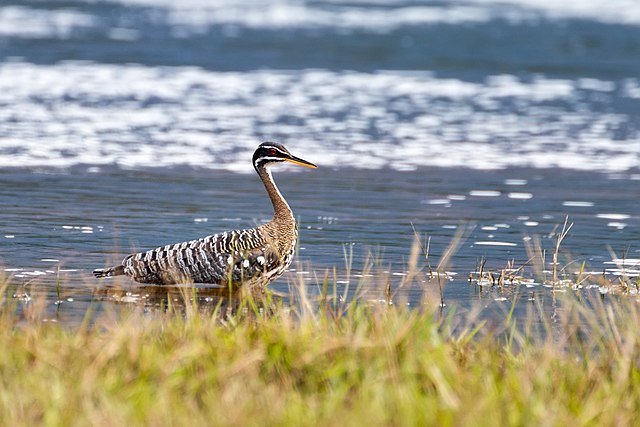
Like its cousin the Kagu, Sunbitterns are known for their striking vocalizations which have been described as doglike barks & growls. At other times, the birds vocalize through soft, melodic whistles, sometimes performed in pairs as a beautiful duet. To hear both types of vocalizations, click here.
BEHAVIOUR
Solitary Hunters
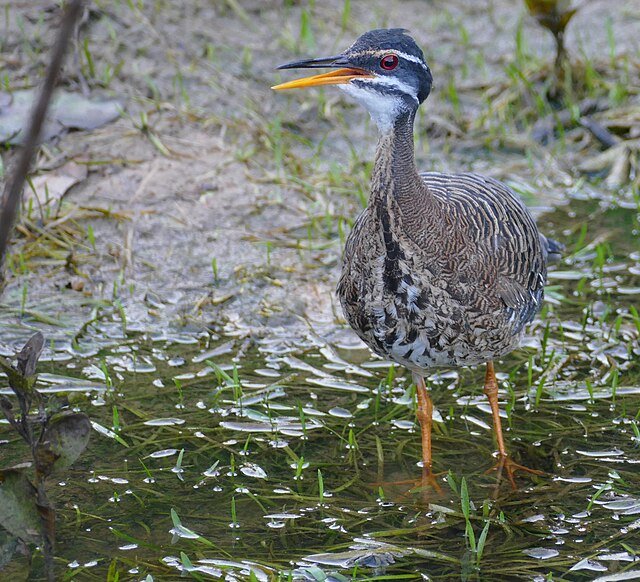
Sunbitterns live quietly, hunting alone within their own patch of forest or wetland. They eat whatever moves—cockroaches, larvae, flies, moths, crabs, shrimp, worms, fish, tadpoles, frogs, eels, and lizards. They favor hidden places: thick riverbanks, swamps, lagoons, and shaded lakeshores. Their slow steps and earthy plumage help them vanish into the background.
Spotting one takes patience. These birds don’t seek attention—they slip through the undergrowth like shadows, leaving only ripples and silence behind.
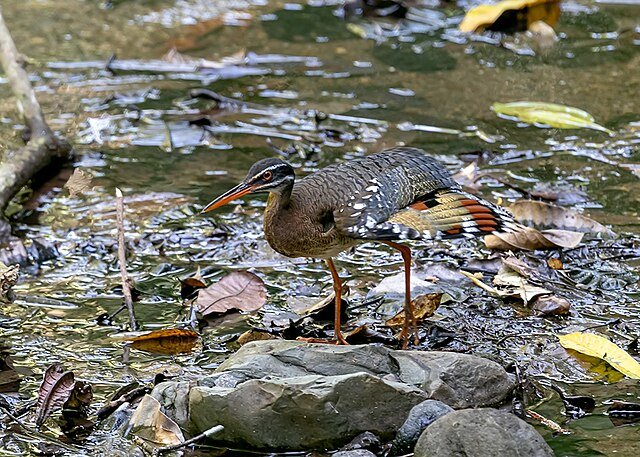
Even with a part of the eye spot showing, the Sunbittern blends into the background – the rocks, river, even the yellow and orange leaves which blend into the eye spot help to conceal the bird’s whereabouts. c/o Charlie Jackson, wikicommons.
Parenting
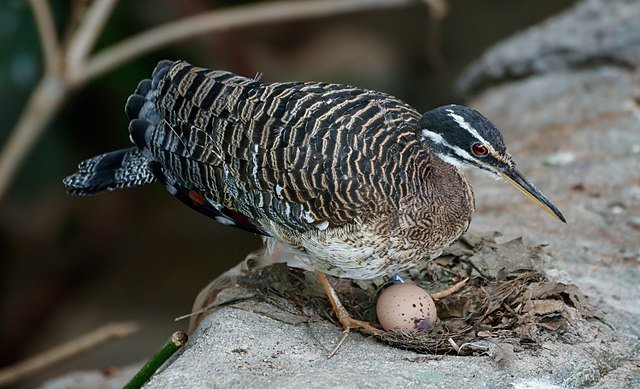
During breeding season, Sunbitterns shift from solitude to teamwork. Males perform elaborate dances—wing displays and head bobs—high in the canopy, sometimes 15 meters above ground. Once paired, both birds build the nest together. They share duties, taking turns incubating the speckled eggs and foraging nearby. Their bond runs deep. Sunbitterns often mate for life, showing strong monogamy and a quiet devotion that mirrors their graceful movements.
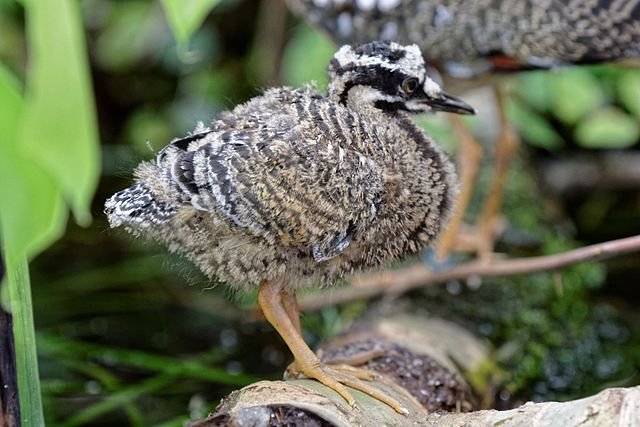
Sunbittern’s ‘precocial’ chicks hatch with eyes wide open, covered in soft down, and ready to move – not helpless in any way! They walk, react to threats, and blend in fast. Though mobile from day one, they stay nestled for a few weeks. Their camouflage helps them vanish into leaf litter and shadows.
KEEP A SHARP EYE!
Sunbitterns thrive in quiet corners of tropical rivers, moving slowly and blending into the shadows with expert camouflage. Their soft calls often vanish beneath rustling leaves and flowing water, making them easy to miss unless you know what to listen for.
Spotting one takes patience and familiarity with their habits. They favor lowland streams, walk with deliberate grace, and rarely draw attention. But if you catch one mid-display—with wings spread wide—you’ll see brilliant ocelli flash like stained glass. That moment, rare and radiant, stays etched in memory long after the bird disappears into the undergrowth.
Do you dream of living in the midst of breathtaking tropical scenery and amongst amazing animals like the striking Sunbittern? At RE/MAX WE SELL PARADISE, we list hundreds of tropical properties – homes, land, farms, estates & businesses – all within a stone’s throw of the amazing rainforests, mountains and beaches that make Costa Ballena a world-famous destination. See our property listings here.
Cover photo cpurtesy of Tony Hisgett


