
Our Strange Olingo
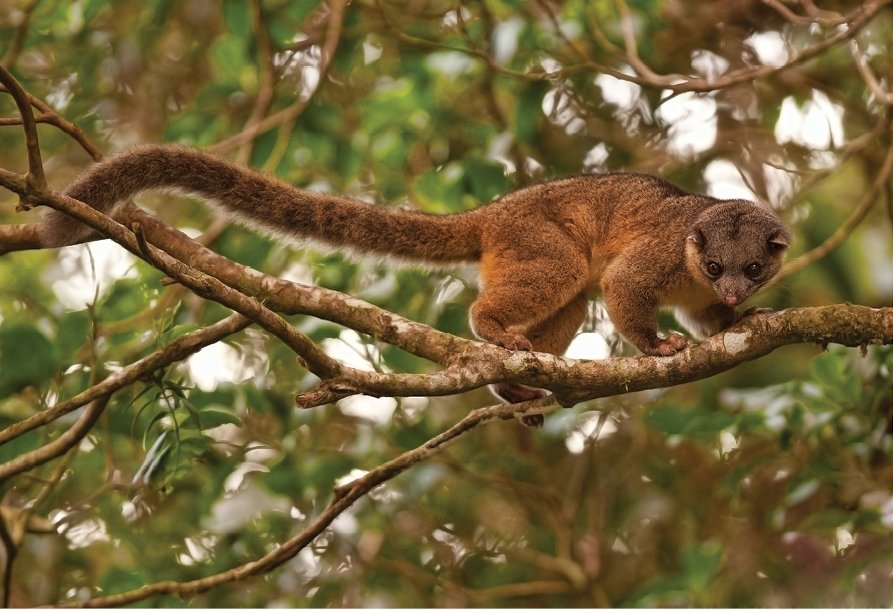
🐾 Northern Olingo: A Quiet Master of the Canopy
The Northern olingo (Bassaricyon gabbii) moves through Central American forests with speed and confidence. Also called Bush-Tailed Olingo, this creature is elusive and rarely seen – yet is is quite common in our forests. But because it prefers undisturbed habitats, it has not woved itself into the Costa Rican lore like the sloth, monleys, toucans or macaws which can be found in towns and even cities.
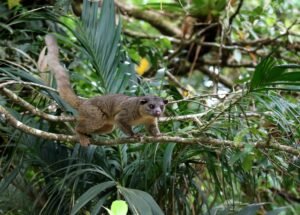
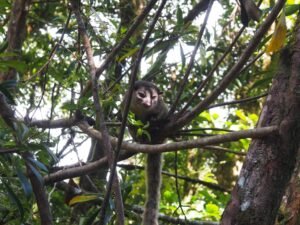
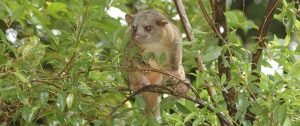
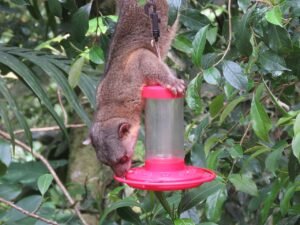
An Olingo photographed in Costa Rica. c/o Thomas Galewski inaturalist
🌳 Appearance, Movement, and Behavior
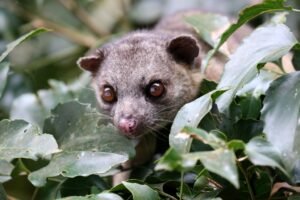
The Northern olingo shows a slender body, long bushy tail, and large eyes that help it hunt and travel at night. Its fur ranges from brown to grey‑brown with lighter underparts and a yellowish throat band. Faint rings mark its tail. Hairy soles and curved claws give it strong grip on branches. It also releases a sharp scent from anal glands when threatened.
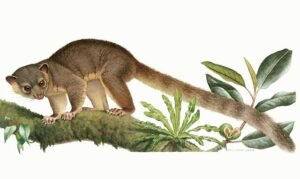
The Olingo climbs with precision and uses its tail for balance., but it does not grip branches with the tail like a kinkajou. It moves fast through the canopy and defends fruit sources with surprising boldness. Its call sounds like a sharp “whey‑chuck” or “wey‑toll.” Researchers once believed it lived alone, but frequent pair sightings show more social flexibility.
To see a short & fun video about the Olingo, click HERE.
🍉 Diet, Habitat, and Ecological Role of the Olingo
The Northern olingo eats mostly fruit, especially fleshy rainforest species. It also consumes nectar, insects, leaves, and small vertebrates when needed. This flexible diet helps it adapt to seasonal changes. Its fruit-heavy feeding makes it a major seed disperser, which strengthens forest health and biodiversity.
It prefers montane and tropical moist forests and avoids disturbed landscapes. The animal sleeps in large tree cavities during the day and stays active at night. It ranges from lowland forests to higher montane zones, but it thrives best in intact, mature canopies.
Northern olingos mate throughout the year, and females usually produce a single pup after a gestation of about 73–74 days. The newborn arrives altricial—eyes closed and fully dependent—and stays in a secure tree cavity while the mother provides all care. The pup opens its eyes at around four weeks and begins tasting solid food by two months, gradually gaining independence as it learns to climb and forage in the canopy.
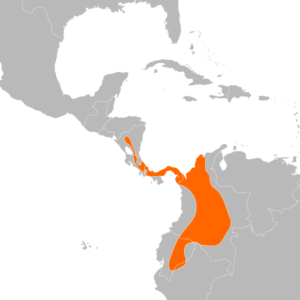
The Northern Olingo ranges across Costa Rica, Nicaragua, Panama, and parts of Colombia. Reports from Honduras and Guatemala remain uncertain because observers often confuse it with kinkajous.
🧬 Taxonomy and Conservation
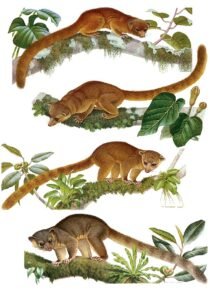
Scientists first described the species in 1876 and named it after naturalist William More Gabb. Modern genetic studies confirm four olingo species and show close ties to coatis, not kinkajous. The resemblance to kinkajous comes from parallel evolution, not shared ancestry.
The Northern Olingo holds a Least Concern status, but habitat loss threatens long‑term stability. Its dependence on intact forests makes conservation of mature canopy systems essential. Protecting these forests ensures continued seed dispersal and ecosystem balance. And Costa Rica is a champion of reforestation, with over 50% of the nation covered by forests (and this number is increasing).
The jungles surrounding our area are teeming with animals that make Costa Rica famous – and you can bet the OLINGO is NOT one of them! Most people have never even heard of this critter – and because of that, discovering the OLINGO feels like finding a secret in the depth of our rainforests. Do you want to live in the midst of our rainforest paradise? At RE/MAX WE SELL PARADISE, we list hundreds of tropical properties – homes, land, farms, estates & businesses – all within a stone’s throw of the amazing rainforests, mountains, beaches and resident exotic animals that make Costa Ballena a world-famous destination. Start your journey to Paradise by browsing our property listings here.
Cover photo c/o Olyngo, wikicommons


