
Our Buzzing Cicadas
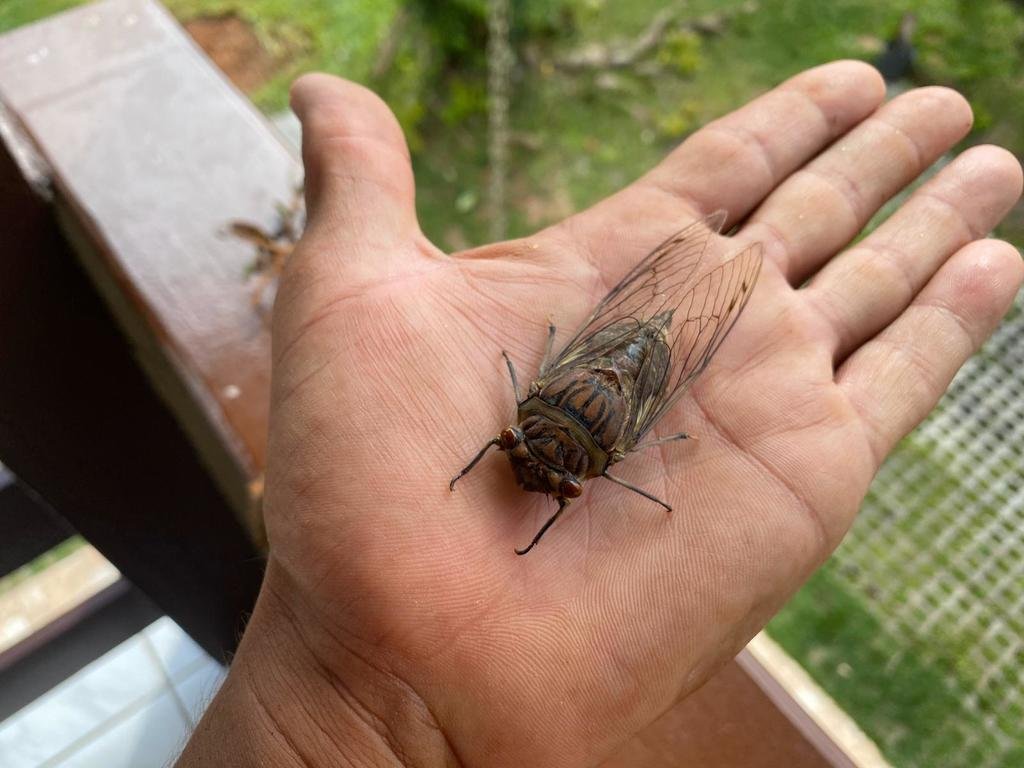
Cicadas are among the most acoustically dominant insects in Costa Rica’s ecosystems, yet their biology remains surprisingly under‑recognized by visitors and even many residents. These insects belong to the superfamily Cicadoidea, a lineage that has existed for more than 200 million years.

Costa Rica’s tropical climate, elevational gradients, and forest diversity support a wide range of Cicada species, each with distinct life histories, morphologies, and acoustic signatures. Their presence is not merely aesthetic; Cicadas play measurable roles in nutrient cycling, soil structure, predator–prey dynamics, and forest phenology.
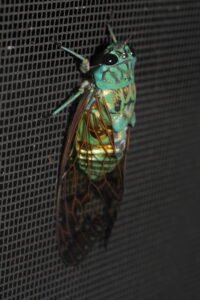
🌳 Diversity of Cicadas
Costa Rica’s Cicada fauna is shaped by the country’s dramatic ecological variation. The Pacific dry forests host some of the largest and loudest species, including Quesada gigas, while the humid lowlands of the Osa Peninsula support species with more complex, modulated calls. Cloud forests harbor high‑elevation specialists adapted to cooler temperatures and reduced atmospheric density, which influences both wing morphology and acoustic output.

Let’s take a look at just three of the dozens of species of Cicadas who call Costa Rica home:
– GIANT CICADAS
Quesada gigas is the largest and loudest Cicada in Costa Rica, and its call can dominate entire valleys during the peak of the dry season. Males produce a powerful, resonant buzz that carries for hundreds of meters, creating the iconic “Cicada roar” familiar across the Pacific lowlands.
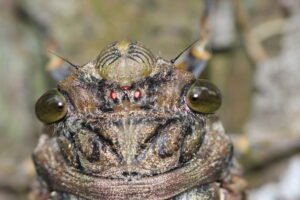
This species thrives in warm, open habitats, especially along forest edges and secondary growth. Adults emerge synchronously, often after the first strong dry‑season heat, forming dense calling aggregations. Their size – 2 inch (5cm) length and 6 inch (15cm) wingspan – and slow flight make them easy to spot on tree trunks or wooden structures. Despite their dramatic presence, they feed quietly on xylem sap and play an important role in nutrient cycling when they die in large numbers.
– EMERALD CICADAS
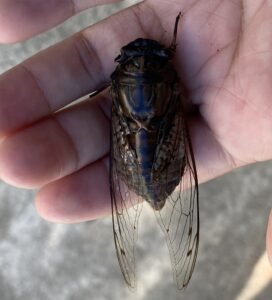
Zammara smaragdina is one of Costa Rica’s most visually striking Cicadas, known for its metallic emerald-green coloration that glints in sunlight.

It inhabits humid forests, especially in the southern Pacific region, where it blends seamlessly with glossy tropical foliage. Its call is high‑pitched and less forceful than that of Quesada gigas, making it easier to hear at close range than across long distances. Adults perch on slender branches and vines, relying on their iridescence and stillness for camouflage.
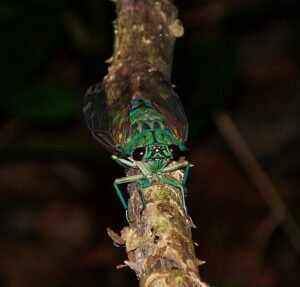
This species is active during the wet season, when vegetation is lush and moisture levels are high. Its jewel‑like appearance makes it a favorite among naturalists and photographers exploring Costa Rica’s rainforest canopy.
– DORISIANA CACHLA
Dorisiana cachla is a bright green rainforest Cicada commonly encountered in Costa Rica’s southern Pacific lowlands. It prefers mature or semi‑mature forest, where it calls from mid‑level branches during warm daylight hours.
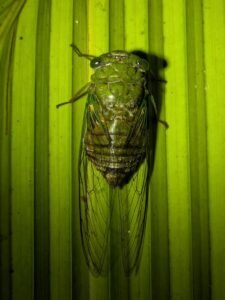
Its song is a smooth, pulsing buzz that rises and falls in intensity, creating a rhythmic backdrop in humid forest interiors. The species’ coloration provides excellent camouflage against mossy trunks and epiphytic plants. Adults emerge during the rainy season, when the forest is acoustically active and competition among calling males is high. As a xylem‑feeding insect, it contributes to the subtle but continuous flow of nutrients within the forest ecosystem.
🕳️ Life Cycle
Cicadas spend the majority of their lifespan underground as nymphs, feeding on xylem sap from tree roots. This nutrient‑poor diet requires high fluid intake and specialized filtering organs called Malpighian tubules, which allow them to process large volumes of water. Their subterranean development can last from one to more than ten years, depending on species and environmental conditions.

Unlike the synchronized 13‑ and 17‑year emergences of temperate North American Cicadas, Costa Rican species follow asynchronous, climate‑driven cycles. Soil temperature, moisture, and photoperiod influence emergence timing, with many species appearing during the early dry season or immediately after the first significant rains.
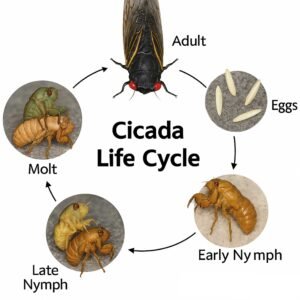
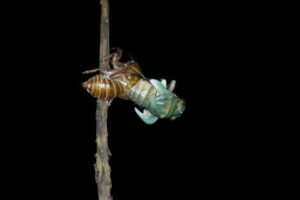
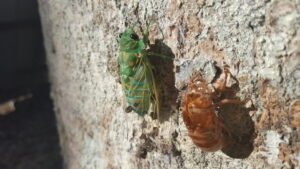
When ready to transition to adulthood, nymphs climb vertical surfaces and initiate ecdysis. The exoskeleton splits along the dorsal thorax, allowing the adult to emerge. During this process, hemolymph is pumped into the wings to expand them to full size. The newly emerged adult, known as a teneral, appears pale due to incomplete sclerotization. Within hours, the cuticle hardens, pigments develop, and the insect becomes capable of flight.
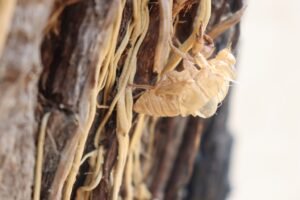
Clusters of exuviae (shed exoskeletons) on tree trunks provide evidence of population density and emergence synchrony. These exuviae are often used in entomological studies to estimate species distribution and emergence timing without disturbing live populations.
🎶 Acoustic Biology: The Loudest Insects in the Tropics
Cicadas are the only insects capable of producing sustained, high‑intensity airborne sound. Males generate calls using tymbals, ribbed membranes on the abdomen that buckle inward and snap back rapidly. Internal air sacs amplify the sound, creating the characteristic buzzing, clicking, or pulsating calls.

Costa Rican Cicadas exhibit remarkable acoustic diversity. Some species produce continuous electrical‑sounding drones, while others generate rhythmic pulses or frequency‑modulated chirps. Temperature strongly influences call rate, with higher temperatures accelerating tymbal contractions.
Acoustic Facts:
- Peak sound levels can exceed 100 decibels, comparable to a motorcycle engine.
- Species partition acoustic space by frequency, rhythm, and time of day, reducing interspecific interference.
- Females locate males through phonotaxis, orienting toward the strongest or most species‑specific signal.
- Some species synchronize their calls to create chorus waves, a collective behavior that may reduce predation risk.
🌦️ Emergence of Cicadas
Cicada emergence in Costa Rica is closely tied to climatic cycles. In the Pacific dry forests, emergence peaks during the early dry season when soil moisture declines and temperatures rise. In contrast, species in the Southern Pacific and Caribbean lowlands often emerge after the first heavy rains, aligning their reproductive cycles with increased plant activity and predator abundance.
Regional Patterns:
- Guanacaste Dry Forests: High biomass emergences and extremely loud species.
- Central Valley: Strong seasonal choruses influenced by urban heat islands.
- Osa Peninsula: High species richness and complex acoustic communities.
- Talamanca Cloud Forests: Specialized species adapted to cooler, oxygen‑poor environments.
🦠 Ecological Functions and Trophic Interactions
Cicadas contribute significantly to ecosystem processes. Their nymphal tunneling aerates soil, enhances water infiltration, and influences root architecture. When adults die en masse, their bodies decompose rapidly, releasing nitrogen, phosphorus, and trace minerals into the soil. This nutrient pulse can temporarily increase microbial activity and plant growth.
Cicadas are also a key prey item for birds, reptiles, amphibians, mammals, and arthropods. During peak emergence, predator satiation occurs: the sheer number of Cicadas overwhelms predators, ensuring that enough individuals survive to reproduce.

😋 Cicadas as Food
Cicadas have been eaten by humans in several parts of the world, especially where insect cuisine is culturally established. They are commonly consumed in China, Japan, parts of Southeast Asia, and by some Indigenous groups in North America, where freshly emerged adults and late‑stage nymphs are collected for their soft texture and mild, nutty flavor. Preparation methods vary, but roasting, frying, and boiling are the most common.
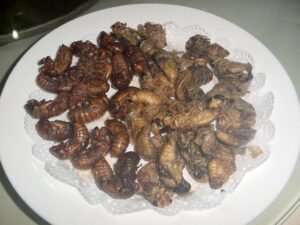
Nutritionally, Cicadas are high in protein and low in fat, making them comparable to other edible insects. Although they are biologically edible everywhere they occur, their use as food is not universal, and in many countries—including Costa Rica—they are eaten only rarely or experimentally rather than as part of traditional cuisine.
Whether enjoyed as a snack, appreciated as a unique & interesting insect, or cursed due to its buzzing that can make talking difficult, the Cicada is a conspicuous part of Costa Rica. Life would not be the same without the seasonal Cicada chorus!
Our annual Cicada chorus is a sign that the dry & sunny season is upon us. They are an integral part of our tropical location and bring surreal vibes. Do you want to live in the midst of our rainforest paradise? At RE/MAX WE SELL PARADISE, we list hundreds of tropical properties – homes, land, farms, estates & businesses – all within a stone’s throw of the amazing rainforests, mountains, beaches and resident exotic animals that make Costa Ballena a world-famous destination. Start your journey to Paradise by browsing our property listings here.
Cover image c/o mirmelon, inaturalist.


