
Sloths of Costa Rica
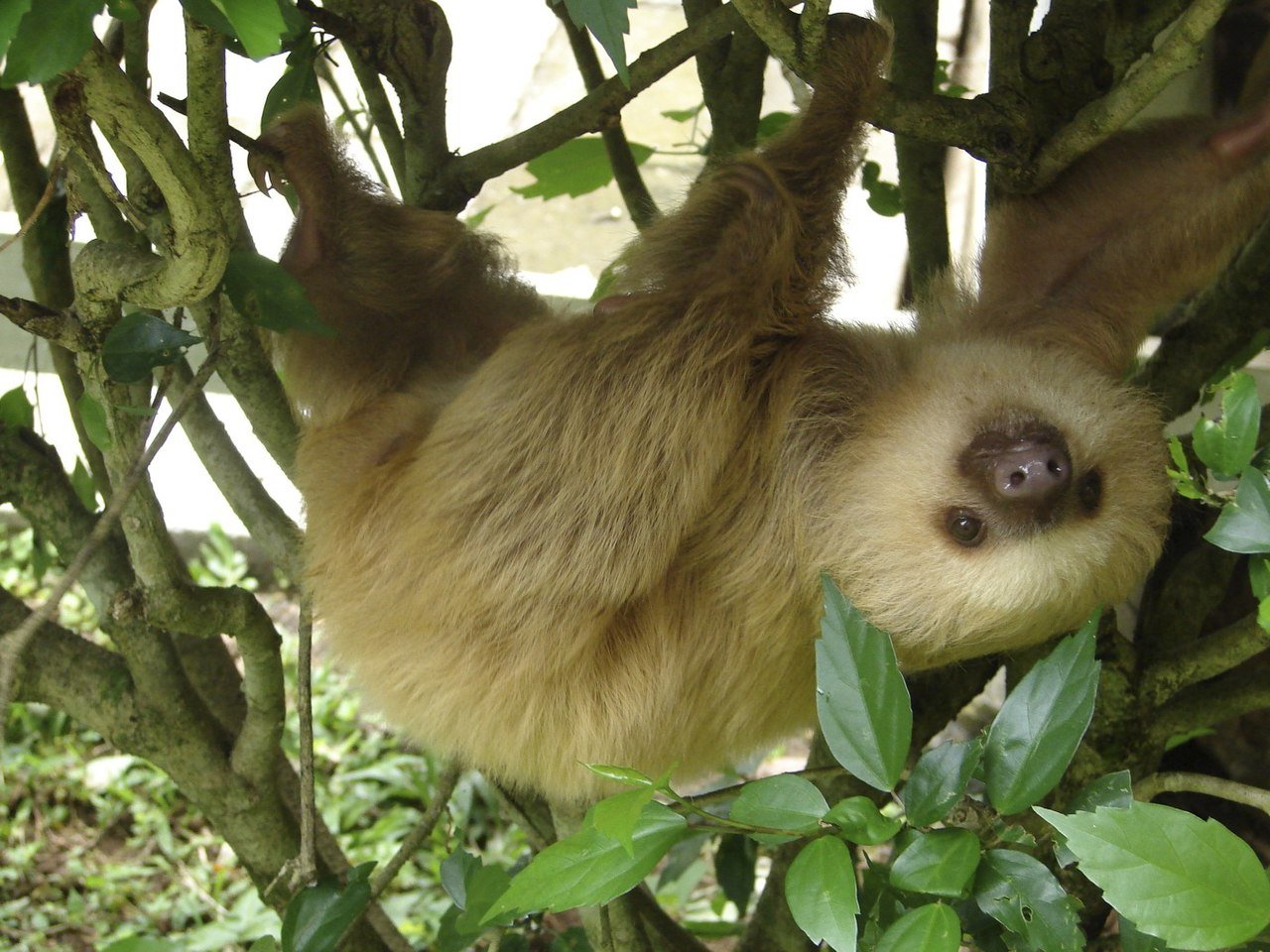
Let’s take a moment to appreciate Costa Rica’s unofficial mascot—the famously chilled-out sloth. In fact, two species share the spotlight: Hoffman’s Two-Toed Sloth (Choloepus hoffmanni) and the Brown-Throated Sloth (Bradypus variegatus). Out of the six known sloth species, these two roam freely across Costa Rica’s forests. You’ll find them from sea level along both coasts all the way up to the misty cloud forests of Monteverde.
These creatures captivate locals and visitors alike with their slow-motion charm and quirky habits. So let’s dive into a few peculiar facts that make sloths so unforgettable.



AMAZING SLOTH FACTS
- Sloths, like many mammals, wear a finer fur covered by larger, coarser ‘guard hairs’ which protect the fur from abrasion and water. BUT the sloths’ guard hairs have evolved microscopic cracks designed to hold moisture and nutrients and thus help to host several species of algae in a symbiotic relationship – the algae get a nice place to live and the sloths are rewarded with a living camouflage.

- BUT WAIT! Sloths have also developed a symbiotic relationship with MOTHS! The Cryptoses moth species are dependent on the sloth to survive – the moths live in the fur and then lay their eggs directly in the sloths’ dung. The larvae develop in the dung and the newly minted moths make their way back to the sloths’ fur which they use as a mating ground – and thus complete the life cycle. In exchange for a home and a home for their larvae, the moths fertilize the sloths’ algae with pieces of sloth dung.
- Sloths’ fur is unusual in that it flows from the belly up towards their heads – not the other way around. This is because sloths spend a lot of time hanging upside down and the unusual fur direction allows rainwater to easily flow down and towards the ground.
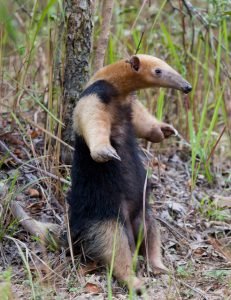
- The sloths’ closest relative is the anteater- and the two-toed and three-toed sloths are not closely related to each other! They evolved separately from a common ancestor, over 28 million years, in what is called one of the most striking examples of convergent evolution known among mammals.
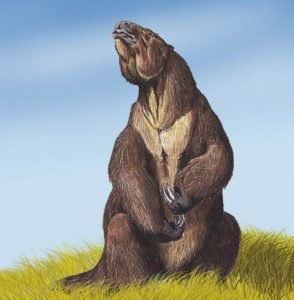
- Extinct giant sloths reached the size of elephants – these animals were wiped out by human hunters following the end of the ice age around 11,000 years ago. BUT some giant sloth populations survived on Caribbean islands like Cuba until some 5000 years ago when humans finally colonized the islands.
- A sloth may take up to a month to completely digest a meal, and up to two-thirds of a sloth’s weight may be the leaves in its digestive system.

- Baby sloths learn what to eat by licking the lips of their mother.
- Two-toed sloths have a diverse diet of animal matter, fruit, and leaves. But three-toed sloths subsist only on the leaves of a few select tree species. The three-toed sloths’ toxic, low-nutrient diet of only tree leaves causes it to have an exceptionally low metabolic rate and the slowest known digestion rate of any mammal.
- Sloths spend most their lives up in trees – coming down only to ‘change a tree’ or, once every 8 days or so, to ‘do their business’.
- Sloths give birth while hanging from the branches. Sometimes, if they are around, other sloths may position themselves under the mother to catch the baby if it slips down after being born.
- Male sloths have an orange patch on their backs called a ‘speculum’ – it is theorized that the size and colour of the speculum is used as a fitness selector – the brighter and larger the speculum, the better chance the sloth has at finding a mate.
HELP A SLOTH CROSS THE ROAD?
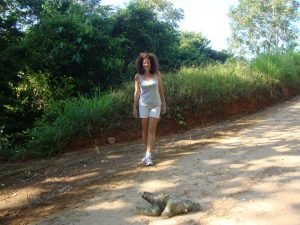
Ben and Heather have had plenty of encounters with sloths—spotting them in the trees around Costa Ballena, finding them in towns like Uvita, hosting unexpected backyard guests, and even helping them cross highways and smaller roads. While sloths generally shouldn’t be handled or disturbed, sometimes a little help makes the difference between life and death. A sloth crossing the costanera faces real danger from speeding cars and may even cause accidents if drivers swerve. On the ground in towns or villages, sloths become easy targets for roaming dogs and other predators.
Use good judgment and prioritize your safety and the safety of others on the road. Sloths can defend themselves with long claws and strong teeth, so wearing gloves or using protective gear is a smart precaution. If you choose to assist one, handle it gently
and keep contact brief. Most people place the sloth on the nearest tree, and the animal usually climbs up and away from harm.
On quieter roads, if conditions allow, the best option may be to stand nearby and warn approaching vehicles. That simple act can give the sloth enough time to cross safely without needing direct intervention.



WHERE TO SEE SLOTHS IN COSTA RICA?
Sloths live in forested areas across Costa Rica and appear especially often in protected zones. Researchers estimate that sloths make up nearly half of the forest mammal biomass. Spotting them proves difficult, though, because they blend in perfectly with their surroundings. Algae growing on their fur helps camouflage them, and they spend about 90% of their time completely still. Many species also move around mostly at night.
The easiest way to find a sloth is to look for people gathered near a tree, pointing cameras at what seems like nothing special. Often, a sloth clings to a branch nearby or creeps slowly through the canopy. Sometimes the crowd turns out to be watching a monkey or macaw instead, but sloths are usually the stars. These locations tend to be ideal for sloth spotting in Costa Rica.
- Manuel Antonio National Park
- Tortuguero National Park
- Corcovado National Park
- Forests around La Fortuna
- Monteverde cloud forests
- Cahuita National Park
- Broadly, the South Pacific area of Costa Rica and especially the Osa Peninsula
- BUT sloths are everywhere in Costa Rica – so always keep an eye out!
WHAT ARE SLOTHS AFRAID OF?
The sloth has a few natural enemies – the huge Harpy Eagle and some of the bigger wild cats of Costa Rica such as the Jaguar, Puma or the Jagarundi (read about Costa Rica’s big cats here: https://www.we-sell-paradise.com/wild-cats-of-costa-rica/ ) actively hunt for sloths. Dogs also prey on ground-bound sloths.
But by far the biggest enemy of sloths in Costa Rica are poachers and uninsulated power lines. Sloths are hunted for meat and for the pet trade – mothers with a baby sloth in tow are the main targets as the global demand for baby sloth pets is high. The babies are taken from the mother and delivered to their new homes in captivity.
Uninsulated or poorly insulated power lines are deadly for sloths, just one touch will kill the animal instantly.

WHAT CAN YOU DO TO HELP THE SLOTHS?
There are plenty of wildlife organizations in Costa Rica which look after the welfare of sloths – after all, 50% of all wild animals brought into rescue centers are sloths. You may wish to become a volunteer, adopt-a-sloth, or donate money. Here are some helpful links, but a further google search is recommended:
- The Sloth Institute, located in Manuel Antonio, Costa Rica, focuses on enhancing the welfare and conservation of sloths through the rescue, rehabilitation and release of hand-raised and injured sloths. While also conducting vital research, conservation and education programs to ensure their survival. https://www.theslothinstitute.org/
- The Sloth Sanctuary of Costa Rica is the original rescue center for injured, orphaned and abandoned sloths. https://www.slothsanctuary.com/
- Volunteer for an incredible sloth and animal rescue center in Costa Rica! This program is open to all volunteers, including vet students. https://www.goeco.org/area/volunteer-in-central-america/costa-rica/sloth-and-wildlife-rescue-center/
- The Sloth Conservation Foundation (SloCo) was founded in 2017 by sloth researcher Dr. Rebecca Cliffe and is dedicated to saving sloths in the wild. https://slothconservation.org/
WHAT ARE THE DIFFERENCES BETWEEN COSTA RICA’S TWO SLOTH SPECIES?
Costa Rica’s two sloth species: Hoffman’s Two-Toed Sloth and the Brown-Throated Sloth are very far-related cousins – they are as different as a turkey is different from a chicken!
Hoffman’s Two-Toed Sloth
- Diet consists of animal matter, fruit, and leaves.
- Active during the night
- Relatively low numbers, rare to see
Brown-Throated Sloth
- Diet consists solely of leaves, especially from the CECROPIA species
- Active during both day and night
- Relatively high numbers, frequently seen


Do you dream of living in the midst of breathtaking tropical scenery and amongst amazing animals like the Sloths? At RE/MAX WE SELL PARADISE, we list hundreds of tropical properties – homes, land, farms, estates & businesses – all within a stone’s throw of the amazing rainforests, mountains, beaches and resident exotic animals that make Costa Ballena a world-famous destination. Start your journey to paradise by browsing our property listings here.


